16.2.6 Academic freedom policy
Srinakharinwirot University Notification of Policy on Academic Freedom
Academic freedom is fundamental to enabling higher education institutions to fulfill their mission of promoting the common good through the pursuit and dissemination of knowledge. Freedom in research is critical for advancing the frontiers of knowledge, while academic freedom in teaching ensures the protection of faculty rights and the preservation of students’ intellectual autonomy. Pursuant to the Royal Gazette of the Kingdom of Thailand, dated December 20, 2021, institutions of higher education are required to uphold principles of social responsibility, academic freedom, institutional autonomy, and equality. Srinakharinwirot University fully endorses these principles, recognizing the corresponding rights and obligations established therein.
1. Definition
“University” refers to Srinakharinwirot University
“Students” refers to students enrolled at Srinakharinwirot University.
“Administrator” refers to individuals in leadership positions responsible for overseeing various aspects of University operations. This includes roles such as the president, provost, dean, department chair, and other administrative staff.
“Faculty members” refers to an individual who is employed by an educational institution, typically in a teaching, research, or administrative capacity.
“Academic freedom” refers to the liberty of faculty, staff, and Students to teach, learn, conduct research, and express ideas without fear of censorship, retaliation, or institutional constraints, provided such activities do not violate legal or ethical standards.
“Freedom of expression” refers to the right of individuals to express their thoughts, opinions, and beliefs without censorship or restraint. This includes the ability to communicate ideas freely in various forms, whether through speech, writing, or other means, and is fundamental to a democratic society and a vibrant academic community.
“Controversial topics” refers to subjects that provoke strong opinions and disagreements, which can be relevant to academic discussions but must be approached with care to maintain focus on the curriculum.
2. In accordance with the Srinakharinwirot University Regulations on the Code of Ethics, all administrators, faculty members, and students are expected to uphold and support both academic freedom and freedom of expression.
3. Srinakharinwirot University affirms that faculty, staff, students, and scholars have the right to express their opinions and engage in academic activities without coercion or interference.
4. The University shall provide appropriate resources and opportunities that foster the exercise of academic freedom, thereby enhancing the knowledge, skills, and potential of both students and staff.
5. Faculty members are entitled to exercise academic freedom in teaching, research, academic service, and the expression of scholarly opinions to advance the University’s academic excellence, while maintaining a commitment to accuracy. All such activities must comply with applicable laws and the ethical standards of the country.
6. Faculty members have the right to conduct research and publish their findings independently, provided they fulfill their other academic responsibilities. Research conducted for financial gain must follow prior agreements established with University authorities.
7. As members of a learned profession and officers of the University, faculty members are free from institutional censorship or disciplinary action when expressing themselves as citizens. Nonetheless, they have specific professional responsibilities: they must ensure accuracy, exercise appropriate restraint, respect differing opinions, and make clear when their personal views are expressed.
8. Faculty members are free to discuss subject-related matters in the classroom but must exercise caution to avoid introducing controversial topics that are not relevant to the course. This guideline does not discourage academic debate, as controversy is essential to scholarly inquiry. Faculty should refrain from persistently presenting material unrelated to their discipline.
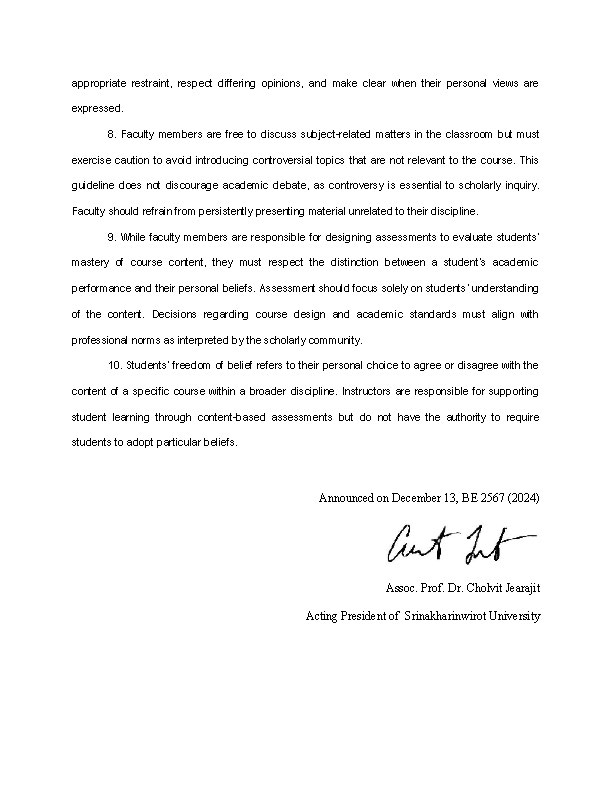
9. While faculty members are responsible for designing assessments to evaluate students’ mastery of course content, they must respect the distinction between a student’s academic performance and their personal beliefs. Assessment should focus solely on students’ understanding of the content. Decisions regarding course design and academic standards must align with professional norms as interpreted by the scholarly community.
10. Students’ freedom of belief refers to their personal choice to agree or disagree with the content of a specific course within a broader discipline. Instructors are responsible for supporting student learning through content-based assessments but do not have the authority to require students to adopt particular beliefs.
Issued on
President of Srinakharinwirot University
In 2024 Srinakharinwirot University has a policy supporting academic freedom, allowing scholars the freedom to choose their research areas and to share and teach publicly about their expertise.
The University actively promotes academic exchange and knowledge sharing to enhance the quality of education and research. Faculty members are encouraged to pursue diverse types of research funding — including projects aimed at international publication, community-based research, and socially engaged research that contributes directly to society.
This commitment to academic freedom is further reflected in the University’s recognition and awards for outstanding researchers across various disciplines, reinforcing a culture that values independent inquiry, creativity, and scholarly contribution to both academia and the community.

Source: https://soc.swu.ac.th/research/nomination-for-a-researchers-day-award-67-swu
Source: https://drive.google.com/file/d/1XsC9TVxB5uQ22g2Lj1RxJWSnBdXoQdPK/view?usp=drive_link